Dispersing the Powder Coat Waste Problem on Journey to Zero Landfill
By William Stough | January 21, 2010
Category:
Because as much as half of powder coat ends up on the paint spray booth floor, it accumulates as waste in large volumes for many manufacturers. It can be one of the most difficult waste byproducts to find outlets for, which is of particular concern for manufacturers seeking to achieve zero-waste-to-landfill goals.
During the early days of the environmental movement, the industrial painting process in most segments transitioned away from liquid surface coating to a dry powder coating technology to help minimize solvent air emissions.
The first widely commercial application of the modern electrostatically sprayable thermoplastic powder coating process was developed in the early 1960s as an alternative to solvent-based liquid coatings containing volatile organic compounds (VOCs).
- Reformulate with black pigments for coating nonappearance, noncolor-spec’d parts.
- Melt resin as raw material for plastic parts.
- Use as bonding agent for carpet padding, sound-deafening material.
- Use as additive to cement,aggregate.
The process of powder coating a component or assembly comprises three main steps:
- Pretreatment cleaning
- Electrostatic spray powder application (it is here that powder coat waste is generated)
- Melting the powder in a heated curing oven
_______________________________________________________________________
Take on the Zero-Waste-to-Landfill Challenge! Participate in our Sustainable Manufacturer Network’s Workshop Oct. 16 in at Crown Equipment Corporation in New Bremen, Ohio. https://www.fmanet.org/events/take-zero-waste-landfill-challenge _______________________________________________________________________
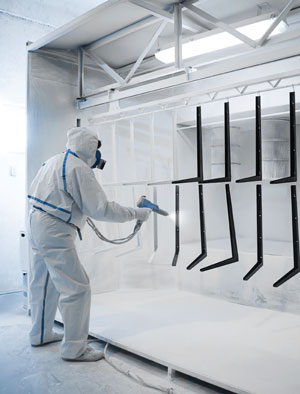
Today’s application technology uses pneumatic pressure to move a powder coating through hoses to hand-held or automated guns that spray the powder with a positive electrical charge onto the component or assembly parts to be coated. Parts are hung on a conveyor line that is grounded so that the emitted powder is attracted to them. An overhead conveyer system moves the parts through the entire
process (see Figure 1).
The powder coatings are made of finely ground, homogeneous plastic particles, each containing a specific proportion of resins, pigments, binders, flow aids, hardening agents, and fillers. The most popular types of resins used to produce powder coat include epoxies, polyester urethane, acrylics, silicones, and hybrid combinations.
VOC Problem Evaporates, New Problem Emerges
Current powder coating technology has an average transfer efficiency of about 50 percent. This means that about half of the powder coats the products, and the remaining half falls to the spray booth floor as waste.

Figure 1
Powder coating, composed of finely ground, homogeneous plastic particles, is forced through hoses to hand-held or automated guns that spray it with a positive electrical charge onto a component or assembly hung on a conveyor line. Photo courtesy of Rapid-Line Inc., Grand Rapids, Mich.
Mass Color Coating. In the early stages of development, powder coating technology was used primarily by manufacturers that had large, consistent production runs of standard products that required the same color. When just one powder coat color is used, it can be collected and reused.
Customization. Eventually demand in certain sectors such as the commercial office furniture industry changed, and customers started requesting more small production runs of custom colors. These new market demands require manufacturers to stop and start the powder coating process to make all of the necessary color changes.
Each color change requires cleaning the pneumatic lines and the spray guns. Because the powder generated from the color changes is a mixture of colors, usually it is collected as waste unless an identifiable market is found for the random mix of colors that accumulates (see Figure 2).
An unintended consequence of meeting market demand for shorter production runs of more and varied colors is the mounting volume and cost of disposing of the resulting waste powder coat.
To accommodate the short runs, manufacturers can order virgin powder coat in smaller containers—typically 20-pound corrugated boxes with plastic liners. To manage the dust and handling issues, they collect the waste powder by hand from the bottom of the spray booths and return it to the original containers. Too often the containers are sealed, stacked on pallets, and sent to the trash
container.
The additional labor and disposal costs may be of concern to company managers, who want to find an alternative to disposing of the waste powder in a landfill. In addition, manufacturers with surface coating operations that aspire to achieve a zero-landfill policy may find that powder coat is one of the last large-volume wastes that ends up in a landfill because of a lack of recycling alternatives. Recycling powder coat waste has become a major concern for those manufacturers.
Small Lot, Early Solutions
Reuse, Reblend on Nonappearance Parts. Manufacturers have found ways to reuse or recycle the powder coat waste they generate internally. One common method is to blend the used powders of mixed colors with a black pigment to create a neutral color that can be used for noncosmetic components.
Melted for Plastic Parts. Another approach is to melt the waste powder, which is resin-based, to form counterweights and other parts.
Additive to Cement. The waste powder can be mixed into cement for dry casting solid blocks.
For many manufacturers with very large volumes of powder waste, however, these approaches offer only partial solutions. Several manufacturers have not found suitable parts or a consistent color to reuse as a neutral color, or melting the resin-based powders into counterweights can be too expensive.
These approaches offer limited success for small volumes, but consistently available large-volume successes have been elusive.
Consortium Addresses Powder Waste
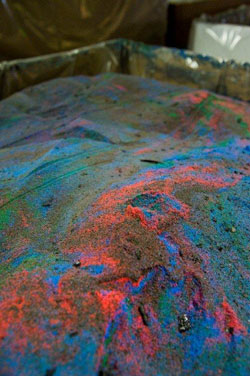
Figure 2
One of the biggest challenges in finding outlets for spent powder coat is that today’s trend for frequent color changes results in a random mix of colors in the waste.
In western Michigan an industrial consortium was developed at the end of 2010 to assess and find alternatives to sending high volumes of powder coat waste to a landfill. The consortium, a spinoff effort of the Green Manufacturing Initiative (GMI) at Western Michigan University, sought to identify common environmental projects among their manufacturing members.
A partnership formed among those manufacturers, the Michigan Manufacturing Technology Center (MMTC), Western Michigan University’s Manufacturing Engineering Research Center, and Sustainable Research Group to create a Waste Powder Coat User Group.
Member companies include office furniture manufacturers American Seating Inc.; Haworth Inc.; Herman Miller Inc.; and Light Corp., a lighting fixture and lighting technology company (see “Office workspace-maker finds cradle-to-cradle resolution for powder coat waste,” p. 16.) The sole aim of the user group is to find ways to reduce the amount of or eliminate powder coat waste sent to landfills for disposal. The initial focus was on effectively recycling it.
The user group first rallied around compiling as much information as they could as a collective group to assess the feasibility of consolidating their waste powder to enhance its value and salability to other manufacturers seeking powder coat as a raw material. They gathered data on the volume of waste generated, how much was reused, how much was disposed of, and how much was recycled.
The group also gathered material safety data sheets (MSDS) for each powder coat paint type used and the price paid for the virgin powder coat. Some interesting data was generated:
- The average price paid for virgin powder coat was $3.47 per pound.
- The average powder coat transfer efficiency (the amount that adheres to the parts) was 63 percent.
- Approximately 4 million lbs. of powder coat waste was generated each year.
- The cost of disposal was $12,700.
- An estimated 68 percent of the waste generated ended up in a landfill (the rest was reclaimed or recycled).
Once this collected data became available, several facts became evident. Powder coat is used in large quantities, and it is expensive. The approximately 60 percent transfer efficiency means that 40 percent of the material is not used for its intended purpose—and that costs a lot of money. Furthermore, most of that 40 percent of powder coat waste ends up in a landfill, for which the generator pays an additional $0.005 per lb. to transport and discard.
Several manufacturers in the group had zero-landfill goals, which made finding ways to recycle the waste the group’s first priority. The secondary and long-term goal was to improve the transfer efficiency to reduce the amount of waste generated.
The group’s hope was to find a regional solution, if possible, for the waste to be used as a raw material for a local company.
Herman Miller found some success in this area through a unique research partnership with a local, family-owned concrete block manufacturer that agreed to experiment with its formulas. The concrete block manufacturer determined that the powder waste could be made into counterweights that the office furniture-maker could then purchase back for its storage units. Although this is a workable solution for some of its powder waste, Herman Miller generates more waste than the block manufacturer can use. Additional demand for the counterweights from other manufacturers could increase the need for waste powder coat.
Haworth found an outlet as the automotive market began to pick up speed after the recession. Research indicated that certain powder coat waste could be mixed with other materials to develop a sound-deadening padding. Haworth was able to provide samples of its powder and the technical data, which were accepted by a padding company that now uses it as a raw material input.
As an extension of its commitment to finding solutions, Haworth has indicated a willingness to allow smaller generators of powder coat waste to use the logistics system that it developed with the recycler so that smaller manufacturers can take advantage of the system too.
One of the group’s smaller powder coat generators recently received notice from a Canadian textile manufacturer to which it had submitted samples of its powder coat waste for testing that the material passed its tests and would be accepted as a raw material. The waste powder will be mixed with other materials that will then be infused into the textile to provide specific properties for the markets the textile manufacturer serves.
Collaboration Multiplies Successes
There are a number of benefits of forming a user group of manufacturers that have similar concerns. Together, manufacturers with similar goals can practice-share and exchange best- and worst-case experiences. This accelerates the learning process and is a very low-cost way to help prevent going down a dead-end path.
It also helps aggregate expertise so that new issues and problems can be researched and implemented with less effort—and cost.
By aggregating volume as well as its data, the user group may find it easier to attract attention from brokers, recyclers, and material users such as the aforementioned textile manufacturer.
The consortium plans to focus its future efforts on improving transfer efficiency and the application process to reduce the volume of powder coat waste generated.
In addition, the group plans to extend its outreach to other manufacturing groups, including the Green Manufacturer Network, which holds zero-landfill conferences and workshops.

Side by side, we move metal fabrication forward.
FMA unites thousands of metal fabrication and manufacturing professionals around a common purpose: to shape the future of our industry, and in turn shape the world.
Learn More About FMA