Sage Supplier: Wind Power Transmission Provides Manufacturing Opportunities
By Kate Bachman | December 20, 2011
Category: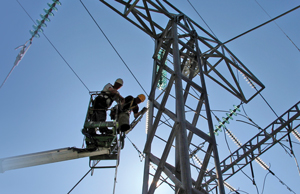
The construction and installation of power transmission lines to carry electricity from renewable-energy resources such as wind farms, usually located in unpopulated areas, to populated urban centers represents a bountiful market opportunity for manufacturers of the associated components and assemblies. Photo courtesy of American Wind Energy Association and Solar Energy Industries
Association
One of the perplexing ironies of utility-scale wind power is that the regions of the continent with the best wind resources are also some of the least densely populated and with the weakest transmission systems (see Figure1).
“There is a high concentration of wind energy in the center of the country but few high-capacity transmission lines in that region,” said Hans Detweiler, director of development for Clean Line Energy Partners, Houston, Texas, a high-voltage, direct-current (HVDC) transmission line developer. “There are lots of great places for wind energy systems where you can’t build them because the current grid is so constrained,” Detweiler said.
During the last decade, new wind energy farms were permitted at the intersection of good wind resources and transmission lines with spare capacity; however, this model has reached saturation, according to Clean Line Energy.
In a Windpower Monthly article last year, Mark Anderson reported that as many as 150 Minnesota wind energy projects were waiting in the queue because of inadequacies in a regional system that has had few wire upgrades in 30 years, even as the state’s electricity consumption has doubled.
Other industry players have come to the same conclusion. “Currently almost 300,000 megawatts [MW] of wind projects, more than enough to meet 20 percent of [U.S.] electricity needs, are waiting in line to connect to the grid because there is inadequate transmission capacity to carry the electricity they would produce,” the American Wind Energy Association (AWEA) and the Solar Energy Industries
Association (SEIA) stated in a 2009 report, “Green Power Superhighways.”
Simply stated, wind power is all dressed up and has someplace to go but cannot get there via today’s aging, outdated power transmission lines in their current locations. Some transmission lines are as old as 80 years.
If the mountain cannot go to the wind, the wind must go to the mountain.
Clean Line Energy, which builds transmission lines to move renewable power, currently is developing four different 500- to 800-mile-long clean-power transmission lines around the country to connect the best wind energy resources with population centers, or load centers, where electricity is needed the most, Detweiler said.
“The company was founded because we believe there’s a need that has been clearly identified in state laws1—and perhaps someday in federal laws—to dramatically increase the amount of renewable energy that we’re using. And the only way to meet that need effectively is to capture the best, most cost-effective renewable resources. So new transmission is needed,” Detweiler said.
Steps to Building Green Power Pathways
Detweiler has gained firsthand knowledge of the challenges involved in installing new transmission lines while working on one of the company’s four transmission line projects, the Rock Island Clean Line, initiated in January 2010. It will be a 500-mile-long, 600-kilovolt (kV), bipole, HVDC line that will move 3,500 MW of wind energy from western Iowa to Illinois.
Transmission line development time lines vary from one project to the next, but 10 years is typical, Detweiler said. The company projected that the Rock Island line is estimated to have an accelerated time line of about seven years (see Figure 2).
“You need regulatory approvals in every state that you traverse. You need to do landowner acquisitions and form contracts with the customers of the line,” Detweiler said.
“We’re basically building tollroads for electricity. So they are financed on the basis of capacity contracts with either load-serving entities like utilities or generators that want to pay to move power,” he said.
1. Mapping Route. The first step is mapping the optimal route to transmit the electricity from utility-scale wind farms to populated urban centers, Detweiler said.
2. Regulatory Approval. The next hurdle is getting federal, state, and local governments’ approval. Detweiler is in the process of seeking approvals for the Rock Island project. “We are developing the route, and we’ve been doing open house meetings for the public.”
Different projects may need different federal approvals, so the review process varies, he said.
“The main challenge is that you’ve got distributed regulatory responsibilities. We don’t need just one permit. For the Rock Island project, we need approval from the Army Corps of Engineers for the Mississippi River and other river crossings; the Iowa Utilities Board for the authority to build and operate a line in Iowa; the Illinois Commerce Commission for the same authority in Illinois; and then the Federal Energy Regulatory Commission regarding the rates that we will charge for the transmission lines. And all of those bodies have their own tests and look at things differently. It can be quite a challenge to pitch all of that together and complete those multiyear regulatory processes.”
The company filed with the Federal Energy Regulatory Commission for approval to seek negotiated rates in December and will file three remaining permits in 2012.
Detweiler expects the states’ regulatory approval process for the Rock Island line to take about 18 months.
“And then at the end of the day, you’ve got to have a product that’s economical,” he added.
Some of the country’s transmission lines, which Detweiler said have been “languishing” for a decade, are now getting a little help with the federal approval process. In an October 5 press release, the Obama administration said it would speed approval for seven transmission line projects in 12 states—together estimated to cost more than $8.5 billion—in an effort to spur infrastructure spending, modernize the U.S. grid, and give consumers more energy choices (see Transmission Lines in Progress sidebar). At least five of those will transmit renewable energy from their sources to urban centers.
3. Land Acquisition, Contract Negotiations. After that the land that the line traverses must be acquired and customer contracts written, he said.
4. Financing, Construction. Next comes the financing of the project construction. After that actual construction takes two to three years, Detweiler said. “So we’re looking at 2016 or 2017 for the line to be placed in service. That’s fast for transmission, especially when you are going 500 miles.”
The total cost of the transmission line is estimated at $1.7 billion.
Manufactured Assemblies and Components

Figure 3
Only a few components and assemblies are unique to renewable-energy power lines. One of these is a thyristor, a type of electric switch. Pictured are arrays of thyristors. Image courtesy of Clean Line Energy Partners.
Most components and assemblies of the line are common to all types of transmission lines, he said. “There’s no difference in a component that’s carrying a renewable electron versus a coal-fired electron.”
These include step-up and step-down transformers, switchgear, system protection equipment, automation controls, clamps, connectors, battery terminals, and conduit boxes.
The transmission line cost includes two converter stations that convert the power from AC to DC near the wind farms and then back again from DC to AC in Illinois, at $250 million each, Detweiler said. “They basically are substations that have switching yards and transformers.”
One of the few substation components that is unique to HVDC converter stations is a thyristor, a type of electric switch (see Figure 3). Thyristors are all custom-engineered, Detweiler said. “The manufacturers of the thyristors are the suppliers of the conversion technology, so there is a high barrier of entry in that industry. The two leading producers in the world are Siemens and ABB,” he said.
The balance of the project cost, $1.2 billion, includes the cost of the cabling, tower structures, land acquisition, and the regulatory costs.
Manufactured assemblies for the transmission lines themselves include cables and cable hardware, an overhead conductor, and tower structures (either a lattice-type or tubular monopole).

Figure 4
Tower structures can be tubular monopoles or lattice-type (pictured). Photo courtesy of American Wind Energy Association and Solar Energy Industries Association.
“Lots of those—between four and seven per mile—so, for 500 miles—at least 2,000 of them,” Detweiler said. “The manufacturing methods for monopoles and lattice-types structures are very different” (see Figure 4).
Detweiler said the company is starting to do outreach to potential suppliers for the line. “We’ve been talking to them about their subsuppliers as well. We have an MOU [memorandum of understanding] with Siemens for design of the converter stations, and we are working to negotiate MOUs with other key component suppliers.”
High-voltage Direct Current
HVDC overhead lines are the best way to move large amounts of power long distances, Detweiler said.
“HVDC results in overall higher efficiency and reliability than an equivalently sized alternating-current system moving the same amount of power, and its lines occupy a smaller footprint,” Detweiler said.
Less energy is lost when it is carried using DC over long distances.
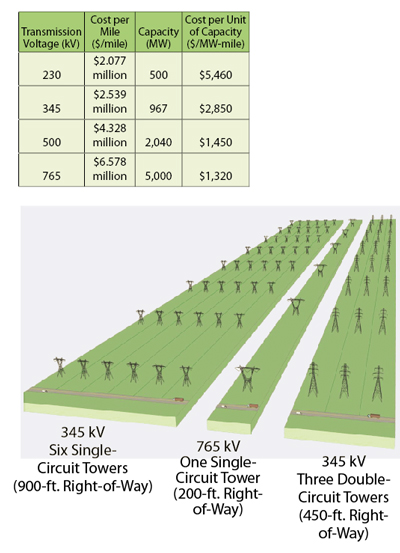
AWEA and SEIA concur. “The key to any cost-effective plan is the use of high-voltage transmission lines in place of the low-voltage lines commonly deployed in the U.S. today,” it stated in “Green Power Superhighways.” In addition, high-capacity transmission lines reduce land use and impact wildlife significantly, compared with lower-voltage lines (see Figure 5). A more robust grid can significantly reduce the cost of integrating wind and solar power with the grid by allowing larger power flows between regions, as well as making it possible to access renewable resources from a greater diversity of areas.
“Different wind turbines use different generation technologies, but all of the collection systems use AC,” Detweiler explained. They’ll collect the power at 34.5 kV AC; then they’ll step it up, probably to 345 kV AC, on lines to get it to the converter station, and then we’ll convert it to DC to transmit over about 500 miles. Then at the other end it is converted back to AC to be injected back into the grid near the load.
“Within DC, there’s really not a good way to transform a voltage, so the best way to transform voltage is to go to alternating current. That’s basically why the whole grid is AC even though many of our appliances and computers use DC. That’s why they have a little converter, that little black box halfway down your plug that converts it to DC.
“Over great distances, DC is much more efficient. It’s not cost-effective if you’re only going 100 miles. But if you’re going 500 miles, then you’ve got significantly lower power losses on the line. This makes DC a more cost-effective investment,” Detweiler said.
Resolving Wind Power’s Variable Loads
One of the major differences between wind power generation and other forms of energy generation is that wind power is variable. This challenge can be well-managed via an extensive and robust transmission line network, Detweiler maintains.
“One of the advantages of a DC system is that you get a lot of control as a result of converting back and forth from AC to DC,” Detweiler said. “So, big picture, with wind and solar energy resources’ variability, the best way to integrate large volumes of renewables is to move them around long distances so that the variability gets averaged out.
“So that’s ultimately what we’re all about—allowing for the integration of large amounts of renewable energy. It’s much cheaper to build new transmission lines, connect the very best wind resources, and blend all of the different regional resources together than to build power generation in less-than-optimal sites. And it’s more cost-effective than battery storage with currently available technology,” he said.
Building Transmission Builds Renewables
The renewable-energy industry cannot continue to grow without a renewed investment in the country’s transmission infrastructure, the AWEA and the SEIA stated in “Green Power Superhighways.”
Building power transmission systems to connect the best wind energy resources with population centers, or load centers where electricity is needed the most, is paramount to the viability of renewable wind energy. The condition and configuration of the current transmission grid is impeding the renewable-energy industry, according to Detweiler.
“The most vexing challenge impeding continued growth in the renewable-energy industry is the lack of expansion of the U.S. transmission grid,” Detweiler and other company leaders said.
The alternative to new transmission lines is to build renewable-power resources at less-than-optimal sites, but that drives up the cost of the energy. “Our point is if you build new transmission lines at 4,000 MW a pop … transmission is a very good way to make a lot of new wind energy possible and to allow the renewable market to develop,” Detweiler said.
“I think a lot of people have been frustrated that the wind energy supply chain got very large and then the bottom fell out of it. There was a sifting through of the companies that were in the field as the industry contracted, and that was a very painful process. Building new transmission can help re-establish manufacturing activity and job creation in renewable energy.
“Robust transmission is a great way to even out the ebb and flow and help the renewable-energy industry to be what it’s supposed to be,” he added.
Transmission Lines in Progress
The Obama administration says it will speed approval for seven transmission projects in 12 states in an effort to connect renewable energy to load centers, spur infrastructure building, and modernize the U.S. grid.
Together, the projects will cost more than $8.5 billion, according to a Bloomberg report. At least five of them will transport renewable energy.
- A $3 billion, 600-kV, 725-mile-long transmission line called TransWest Express is being developed by billionaire Philip Anschutz that would connect energy from a 2,500-MW wind farm his company is building in south-central Wyoming to Southern California, Nevada, Arizona, Colorado, and Utah.
- The $450 million, 500-kV, 300-mile Boardman-Hemingway transmission line, part of the Idaho Power transmission line, would ship hydropower and wind power, as well as electricity generated from coal and natural gas-fired power, between Boardman, Ore., and Melba, Idaho.
- The $825 million, 500-kV, 210-mile-long Cascade Crossing project being developed by Portland General Electric Co. would ship power to populated areas in western Oregon from wind farms in the eastern part of the state and from gas-fired power plants that might be built to replace power from the Boardman coal plant, which Portland General plans to shut down in 2020.
- The $920 million, 500-kV, 460-mile-long SunZia project will ship solar, wind, and geothermal power from remote areas of New Mexico and Arizona to Tucson, and from there to other cities in Arizona and Southern California. That line is being developed by UniSource Energy Corp.’s Tucson Electric Power unit; Tri-State Generation and Transmission Association; Royal Dutch Shell PLC’s WindEnergy
unit; and Salt River Project, an Arizona public utility district. - The $490 million, 345-kV, 150-mile-long Hampton-Rochester-La Crosse transmission project that will run between Hampton, Minn., and LaCrosse, Wis., will comprise a series of transmission lines being developed by 11 utilities, including project manager Xcel Energy Inc. The lines are expected to help meet Minnesota’s Renewable Energy Standard (RES), which requires utilities to deliver 25 percent
of their electricity from renewable sources by 2025—most of that from wind energy, the utility said.
Sources: White House press releases and Dow Jones Newswire
Note
- Currently 27 states and the District of Columbia have renewable-energy standards (RES), according to the U.S. Department of Energy, Energy Efficiency & Renewable Energy. Five additional states have set voluntary goals for adopting renewable energy instead of portfolio standards with binding targets. http://apps1.eere.energy.gov/states/maps/renewable_portfolio_states.cfm.
American Wind Energy Association, www.awea.org
Clean Line Energy Partners, 1001 McKinney St., Ste. 700, Houston, TX 77002, 832-319-6310, www.cleanlineenergy.com
Solar Energy Industries Association, www.seia.org

Side by side, we move metal fabrication forward.
FMA unites thousands of metal fabrication and manufacturing professionals around a common purpose: to shape the future of our industry, and in turn shape the world.
Learn More About FMA