Saving HVAC Energy at the Motor
By Paul Lin | March 26, 2013
Category:- Hot and cold water circulation pumps, large air handlers, fan coils, and variable-air-volume (VAV)boxes are prime candidates for motor retrofits.
- Top efficiency electric motors include NEMA Premium® integral horsepower motors, permanent magnet integral horsepower motors, and variable-speed electronically commutated motors.

Many times a sustainable building retrofit involves multiple complex renovations on both the building’s interior and exterior. The task of understanding and prioritizing the energy-reducing projects can be daunting, and the effort and expense not easily cost-justified. However, great potential energy savings can be found in what drives the equipment that delivers conditioned cool or hot air to the building.
A green retrofit of an existing factory can be as simple as installing a new motor for the heating, ventilating, and air conditioning (HVAC) equipment components.
A building’s HVAC energy system manages indoor temperature, humidity, air cleanliness, and air distribution throughout the premises via various systems such as hot and cold water circulation pumps (see Figure 1), large air handlers, fan coils, and VAV boxes (see leading photo).
HVAC system efficiency improvements can increase the overall efficiency of a motor and drive system, lowering energy use as well as reducing plant downtime. Upgrading the motor is a quick and easy energy improvement.
Replacing an inefficient electric motor with a NEMA Premium® integral horsepower motor, permanent magnet integral horsepower motor, or variable-speed electronically commutated motor can save a plant thousands of dollars in energy and operating costs. These savings may pay off the motor retrofit installation price in only a few years.
Most of these motor and pump replacements can be performed by a staff engineer or your local mechanical contractor. If you desire a more specialized drive application or complicated changes, it is advisable to consult your commercial-grade HVAC contractor to see if you need to work with a design/build firm.
Making Motor Upgrades
Often the motors that are installed originally with HVAC equipment in buildings are not those with the latest technology that can deliver the most system efficiency. In the integral horsepower range, NEMA Premium efficiency motors can be retrofitted to systems that were designed before the establishment of minimum efficiency standards for electric motors as well as to Energy Policy Act (EPAct) efficient-rated integral horsepower motors.

Figure 1
Changing out a hot or cold water circulation pump with a more energy-efficient one can net substantial energy savings.
It’s important to consider that many electric motor-driven devices operate at full speed even when the loads they are serving are under capacity. An oversized motor may be loaded to only half its rated load and use only half the full load input power. The energy savings can be only half as great as a motor running at its full rating point, making it a good candidate for replacement with a smaller motor.
Installing a variable-speed drive allows the motor’s output to match its load’s actual demand, drastically reducing the motor’s watt draw through the cubic relation between speed and watts. For fractional horsepower motors that typically are found in VAV boxes, fan coils, walk-in coolers and freezers, and rooftop package units, electronically commutated motors can be retrofitted to match current systems while decreasing watt usage as well as operating the equipment at variable speeds to take advantage of part load reductions.
Motor Switch in Six Steps
Take time to select the right motor for your HVAC system and then follow these six steps to install the upgrade.
1. Conduct a simple motor audit.
• Take a picture of the HVAC equipment, including the motor that is powering the unit. Pay attention to how the motor is mounted, noting if it is base-mounted, bellyband-mounted, and so forth.
• Record the equipment unit model number, serial number, and the motor nameplate information. The nameplate description lists specific information about the motor characteristics, complying with the National Electrical Code®. By thoroughly inspecting your equipment, you’ll be able to identify any problematic components that need to be repaired, adjusted, cleaned, or replaced. You’ll also be able to record control settings and operating schedules for each air handling unit.
Also record the equipment-specific performance information. For example, on pumps, record the gallons per minute and/or pounds per square inch reading. For air handlers, record revolutions per minute of the fan blades or cubic feet per minute measurements from sensors downstream in the duct.
• Estimate annual run hours based on current run time, setback temperatures and time, and building automation controls.
• For each unit that is tied to a thermostat, record temperature settings, setback settings, time of use settings, and fan speed settings. This will help you identify areas for improvement in controls and control settings that can make your equipment operate more effectively. If applicable, record the speed selections in each mode of operation.
2. Calculate your energy savings.
An important first step in calculating the potential energy savings of the newly upgraded motor is knowing your energy consumption and utility rates. Compare the building’s previous energy use to future use by examining the utility bill and understanding the charges being applied.
Operating load and time substantially affect savings. A motor operated on a two-shift, five-day schedule uses twice as much power as the same motor operating on one shift. Meaningful calculations must reflect an effort to incorporate typical average values for these variables.
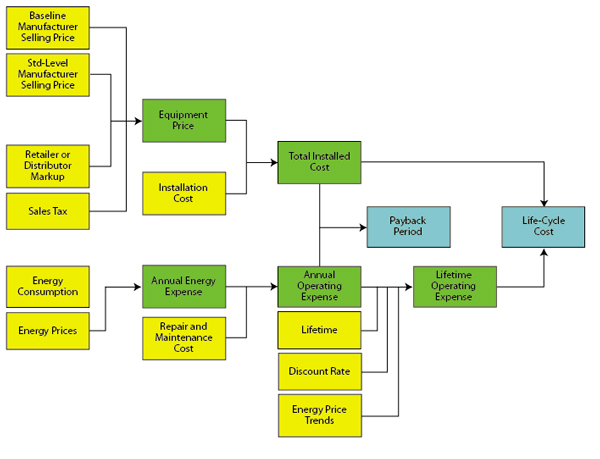
In a document called Life-Cycle Cost and Payback Period Analysis (see Figure 2), the Department of Energy provides an in-depth overview of life-cycle costs and
payback period inputs for a deeper understanding of total installed cost and operating costs of an integral horsepower motor.
Now you’re ready to install a new motor in your system.
3. Mount the motor using the appropriate frame.
For integral horsepower motors, install the motor in the equipment while taking special care to accurately align the motor shaft to the coupling. Make sure that the motor is secure and stable as you mount it to the equipment. Mounting brackets can be used to mount fractional horsepower motors to the existing blower wheel housing.
4. Make electrical connections.
For integral horsepower motor replacements, often you can use the existing wiring. For electronically commutated motor replacements, make sure that you follow the manufacturer’s instructions on installation and mounting of the new motor. The wiring is slightly different than that of the original motor, but it is not overly complicated and it can be retrofitted into existing systems.
If the HVAC system has multiple speed connections, be mindful of reconnecting the new motor to match the speeds.
5. Heed motor and system requirements.
Each system’s motor operation may have unique requirements, so follow all instructions and warnings carefully to ensure safe, efficient use. For example, in a natural gas furnace motor replacement, make sure you have proper cubic feet per minute per ton cooling as well as maintain the delta-T temperature rise as specified by the manufacturer.
For pumps, be sure to maintain minimum flow rates and pounds per square inch as specified by the manufacturer. Often these values are in the installation manuals or available from the manufacturer’s technical support.
6. Test the system.
After installing your new motor, it is important to verify that the motor will provide the proper airflow or flow rate in all modes of operation for maximum performance, comfort, capacity, and safe operation. Compare previously recorded parameters to ensure there is no change in the system (i.e., water pressure or fan blade revolutions per minute).
It’s important to conduct research and understand proven technology before you upgrade an HVAC system as a whole or components of the system. A little upfront work goes a long way in reducing energy consumption, improving building efficiency, and creating comfortable indoor air quality well into the future.
Many systems achieve these goals while requiring minimal maintenance. If you make the right choices, you’ll spend less time on maintenance and more time on your numerous other building management demands.

Side by side, we move metal fabrication forward.
FMA unites thousands of metal fabrication and manufacturing professionals around a common purpose: to shape the future of our industry, and in turn shape the world.
Learn More About FMA