Snack-maker Keeps Plant Toasty Using Heat Recovery
By Kate Bachman | November 28, 2012
Category:- Waste heat generated during the manufacturing process is captured and redistributed through-out the plant for reuse to heat the facility and to heat water for cleaning and corn cooking operations.
- Recovered heat provides more than 80 percent of the facility’s heat during winter months.
- Waste heat recovery has reduced the company’s greenhouse gas emissions by 25 percent over the last six years.

Frito-Lay Beloit Manufacturing Director Mike Stahl led the plant’s sustainability team in implementing one of the most cost-effective, energy-reductive initiatives.
Wisconsin knows cold.
Bordered by Lake Superior, upper Michigan, Lake Michigan, and the Mississippi and St. Croix Rivers, Wisconsin has an average annual temperature as low as 39 degrees F in the north. The state’s lowest temperature on record was -55, reported in the town of Couderay, according to the National Climatic Data Center. During more than half of the winters, temperatures fall to -40 or lower, and
temperatures of -30 or colder are reported from northern stations almost every winter.
Hey, Green Bay Packer fans don’t don those cheesehead hats just for looks.
During Wisconsin winters, heat is a precious commodity not to be squandered. At least one Wisconsin manufacturer knows how to make the most of its heat.
The Beloit, Wis., Frito-Lay plant manufactures about 600 million bags—of Lay’s® and Ruffles® potato chips, Fritos®, Doritos®, Tostitos®, and Cheetos® chips annually for Packers fans and other snack lovers in a 10-state Midwestern region.
Inside the plant, the temperature is downright toasty, but most of the plant’s heated air is not originally heated for that purpose. More than 80 percent of the facility’s heated air—and a large percentage of its heated cooking water and oil and water for cleaning—is sourced from heat first produced on the food processing lines and then recovered and redistributed.
Remember Lay’s potato chips’ classic slogan, “You can’t eat just one”? Once the Beloit Frito-Lay plant successfully recovered and reused waste heat in one area of the plant a year ago, it couldn’t stop, and continued to find new ways to do so.
Reusing Heat Five Ways
1. Heat Process Oil. The plant’s first big waste heat recovery project was on its tortilla chip line, said Mike Stahl, manufacturing director. It is one of the sheeted “corn” lines on which the manufacturer makes Doritos (see Figure 1).
The company recovers exhaust heat from the tortilla chip ovens, directs it through a heat exchanger, and reuses it in the process cooker. “It reduced our natural gas on that line by 50 percent,” Stahl said.

Figure 1
The first heat recovery project was capturing exhaust heat from the Doritos line toaster ovens and directing it to preheat oil at the cooking process heat exchanger.
“This waste heat produced in the ovens would just go to atmosphere, normally,” Stahl explained. “Now we’re capturing it and harnessing it back into the process oil, which allows us to reduce the use of natural gas on that burner. When we’re in recovery mode, which is nearly 100 percent of the time, we duct that heat over, down and up through the bottom of that heat exchanger,” he said.
Evaluating Options. Stahl, along with Jim Zisser, Beloit site project manager, the headquarter’s department of energy, and other technical team members at the site, looked at a handful of different options initially, such as piping the oil through the stacks, but concluded that there was too much oil volume in the system, which would have risked having the oil quality degrade.
Stahl and his team also considered using an intermediate fluid, mineral oil, to transfer the heat, an approach used by another company plant in San Antonio. They concluded that, although that approach worked well on a smaller production platform, it would have resulted in excessive handling on a larger-scale production like theirs.
Then the group collaborated with a consulting firm that did some engineering work to see if capturing the exhaust heat and moving it to the heat exchanger could work. When the results showed that it could, the firm recommended that approach.
“It was the right idea—the simplest idea,” Stahl said.

Figure 2
The second heat recovery project was recovering waste heat from the potato chip line and reusing it to heat the plant’s air. It recovers 12 million BTUs an hour and supplies most of the plant’s heated air. Stahl called it “the big kahuna.”
2. Heat Facility Air. Despite the challenges the team encountered, tasting the success in heat recovery on the Doritos line whet the team’s appetite for more heat recovery projects. “When you complete one heat recovery project, and yield great performance, you figure out how to establish a new vision to overcome the next performance challenge,” Stahl said.
Stahl and his team looked next at its potato chip line for more waste heat recovery opportunities. “The big kahuna is the PC [potato chip] waste heat recovery system,” Stahl said. “Making potato chips is very energy-intensive.”
Heat exhausted from the potato chip line is ducted up to the roof where another heat exchanger resides and captures the waste heat (see Figure 2).
Glycol is pumped up to the roof through the heat exchanger on the PC 50 potato chip process stack. That hot glycol is redirected around the roof of the entire facility and it enters specific HVAC units. Each HVAC unit has a control valve which modulates how much hot glycol passes through the HVAC unit to control the inside supply temperature, which varies depending on the temperature of the incoming air. “All of the free heating for the glycol loop is supplied by the heat exchanger recovery system. The supply piping feeds a simple heating coil that was installed in each HVAC unit.” “We’ve got an energy management system that controls the entire system,” Stahl said.
“As a result, we were able to recover 12 million BTUs an hour off of that process,” he added. “It saved us 2,400 metric tons of CO2 emissions annually.
“More than 80 percent of our footprint is heated for free during the winter months because of that process,” Stahl added.“It was more risky, but we had discovered that approach from other company locations. So we imported best practices,” he said.
3. Heat Potable Water. Surplus waste heat energy from the potato chip line is directed into a mechanical room to preheat potable water, which is then stored in a 10,000-gallon hot water storage tank (see Figure 3). The water is being used for product prewashing and for preheating the plant’s corn cook water. When the potato chip process is not running, the plant now uses a high efficiency direct-contact hot water heater to supplement the potable load versus using a steam heat exchanger.
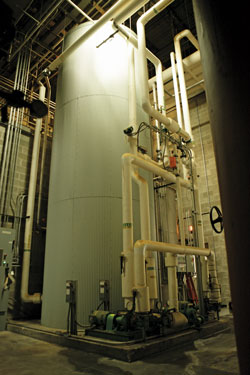
Figure 3
The second heat recovery project was recovering waste heat from the potato chip line and reusing it to heat the plant’s air. It recovers 12 million BTUs an hour and supplies most of the plant’s heated air. Stahl called it “the big kahuna.”
“This is a direct-contact hot water heater. It runs at 99 percent efficiency. To make hot water, a boiler is significantly less efficient, because you have to make steam and then heat water in a tube and in a shell heat exchanger,” Stahl said.
Before the team installed the direct-contact hot water heater, it was also using steam from the boiler to heat the glycol during production downtime windows, which is the intermediate fluid that transfers the energy from the stack into the building for air heat or into the water.
“Now, rather than using steam to heat water, we’ve gone to this.
“Using this more efficient unit means less steam load on your boiler system. So then our boiler has to run less, and that means less natural gas usage,” Stahl said. “It’s free energy.”
Currently the team is working on recovering waste heat from a compressor to heat the water as well.
4. Dry Starch. Another way that the company is reusing heat is to dry the residual starch remaining in the water that is reclaimed from potato slice washing operations (see Figure 4). Through the use of hydrocyclone separators and a vacuum drum system, the starch is separated from the water. In a second step, recovered heat that is recovered from a separate process’s direct-fired heat exchanger is used to dry the starch, which is
then sold for other industrial applications.
“So we’re reusing the water and we’re drying the starch for free,” Stahl said.
5. Cool Air. The most recent heat recovery initiative is in process. The packaging area of the manufacturing plant must be air-conditioned to maintain product quality. The next phase of the waste heat recovery plan, Phase 3, is to run a new adsorption chiller with energy from waste heat from the potato chip line to cool the packaging area (see Figure 5).
“Right now hot glycol is going to the roof to heat the building. We’re in the process of installing an adsorption chiller that will take the potato chip process waste heat in the summer months and air-condition our packaging room,” Stahl said.
“So in the summer when we’re not heating the building, all of that hot glycol be used to run an adsorption chiller to chill water. The chiller will be connected to a chilled water loop on the roof that will go to the packaging HVAC units.”
Green Without Compromising Taste
Many of the challenges the team encountered in implementing the heat recovery system centered around the need to adjust the heat intake so it would not interfere with the product quality. Heat may be valued, but taste is revered.
“As we do these energy conservation initiatives, we never want to compromise product quality,” Stahl said (see Making Fritos®, Cheetos®, and Doritos® crisp and toasty). “And there have been challenges at times.
“We’ve had learnings on the Doritos process where intially we were holding back too much heat and not drafting our toaster ovens adequately. We’ve really worked with our manufacturing operations support group and our headquarters team to find the right balance.”
A lot of thermodynamic engineering was needed, Stahl said. The heat exchanger had to be modified for the recovered heat input. A large heat exchange section was mounted on top of the exchanger to channel the waste heat into the oil. When the heat exchanger was redesigned to absorb the heat, the firing rate of the heat exchanger itself had to be reduced, Stahl said. “So not only did we have to re-engineer the bundle, we had to do some burner reconfiguration to fire at a lower turn-down rate,” he said.
Normally these heat exchangers are engineered with a large burner in the back and tubing inside designed to pick up radiant heat. “However, the heat coming from the ovens is convective, not radiant heat. So we designed the tubes differently—with fins on them—to absorb that heat.”
Similarly, Stahl commented that there were learnings on the potato chip heat recovery system as well.
“We have the heat recovery system on the potato chip line running more efficiently now than when we started up because we learned how to better leverage the energy in that glycol. We weren’t necessarily balancing the use of that heat energy in the correct locations of the facility,” Stahl said.
How Heat Recovery Fits Into Sustainability Plan
The waste heat recovery project is part of a plant and global corporate strategy to conserve energy and reduce greenhouse gases as part of its broad sustainability plan.
Frito-Lay North America, with headquarters in Plano, Texas, is a $13 billion convenient-foods business unit of PepsiCo, Purchase, N.Y.
With annualized revenues of nearly $60 billion, a presence in 200 countries, 3,000 products distributed worldwide, and 300,000 associates across the globe, PepsiCo management is keenly aware of its leadership position and its ability to have an enormous influence on environmental, social, and economic conditions.
The corporation’s business model weaves performance through the triple bottom line, explained Joe Thomas, director of PepsiCo sustainability supporting both Frito-Lay North America and Quaker Foods North America.
“Sustainability is part of PepsiCo’s business model,” Thomas said. “Pepsi-Co’s people are united by our unique commitment to sustainable growth, called Performance With Purpose. PepsiCo balances strong financial returns with giving back to our communities worldwide.
“This has been led by our CEO, Indra Nooyi. She has been the architect behind the Performance With Purpose platform, which integrates human, environmental, and talent sustainability with our performance,” he said.
“Performance with purpose leads into our promise of PepsiCo [see Figure 6]. We want to be able to deliver growth by investing in providing a healthier future for people and
our planet. And we want to make sure it’s long-term profitable growth without depleting any natural resources,” Thomas added.
The Beloit plant aspires to embody PepsiCo Frito-Lay’s overall global strategy, Stahl said, which includes net-zero goals. The team has been evaluating which technologies are feasible and will offer a reasonable return on investment.
“From environmentally sustainable excellence, we in Beloit have a strong heritage of performance,” Stahl said. In the last 10 years, the Beloit Frito-Lay plant has reduced (by percent per pound of finished product produced) its water usage by 50 percent, electrical consumption by 20 percent, and natural gas consumption by 40 percent, Stahl reported (see Figure 7).

Figure 7
The Beloit plant has reduced water usage by 50 percent per pound of product produced in the last decade, natural gas usage by 40 percent, and electricity usage by 20 percent. The company estimates that these energy use reductions have lowered greenhouse gas emissions by 25 percent in six years.
Water, Natural Gas, Electricity. “Over the last six years, with 2005 as a benchmark year, we’ve seen well over a 25 percent reduction in our CO2 equivalents related to natural gas or scope 1 emissions at the site,” Stahl said.
The plant is in the process of converting 25 percent of its tractor trucks to compressed natural gas (CNG) trucks.
In addition, the site has reduced its landfill deposits to less than 1 percent. Most materials are recycled or reused, including the seasoning bags, packaging film, film cores, and dripback oils. More than 99 percent of cartons, which are used to stack the product on retail shelves, are reused up to 10 times and then recycled. More than 3 million lbs. of starch is removed from the cook water and then sold to other manufacturers for use in a variety of products such as adhesives and paper whiteners.
“We waste nothing!” Stahl added.
But it is the waste heat recovery initiatives that represent the most significant energy efficiency improvements, Stahl relayed. “Waste heat recovery is a big element of our sustainability portfolio here,” he said.
Catalysts. One of the catalysts for the heat recovery initiative was an intracorporation innovation contest. “We’re very competitive with other PepsiCo plants,” Stahl said.
Another driver was a cost reduction goal. “When natural gas prices were fairly high, we had a pretty big productivity algorithm for this site that showed fuel could be up to 25 percent of the productivity target for the next year’s annual operating plan. At that point in time, natural gas was about $13 a dekatherm, so there was very high economic motivation for us to get something in place.
“I have to give credit to the organization because they helped us get the financial support for this. Frito-Lay is part of PepsiCo, and when we have a great initiative like this, they find ways to invest capital back into the business, especially when we know we’ll get a high economic return.”
Many synergies have been created cross-company. While the Beloit plant drew direction and inspiration from the parent company’s sustainability strategy, other PepsiCo sites have been able to benefit from the Beloit plant’s experience. “This site has also served as a benchmark for Quaker,” Thomas said. “We took a lot of their learnings and reapplied their tools, rather than re-creating them. That accelerated the program.”
Cornucopia of Awards
The site’s sustainability accomplishments have earned it numerous awards locally, statewide, and nationally. The large collection of awards reflects the depth and breadth of the site’s green endeavors:
- 2012 EPA Clean Air Excellence Award
- 2011 Wisconsin DNR Clean Air Award
- 2010 USGBC LEED® Gold EB – Wisconsin’s first food manufacturer recipient
- 2009 Wisconsin Manufacturer of the Year Award, Grand Award, Sustainability
- 2010 Business Friend of the Environment Award
- 2010 EPA WasteWise Partner of the Year Award
- 2009 Wisconsin Green Tier Acceptance
- 2009 Wisconsin DNR Clean Air Award
- 2009 Governor’s Award for greenhouse gas emission reductions
The site received a $3.25 million grant from the state’s Department of Energy to fund several energy projects, including the adsorption chiller.
Employees Credited. With 700 employees, the plant is the city’s second-largest employer. Stahl attributed the plant’s success to those employees.
“When we were at the EPA Clean Air Award receiving our recognition, we had to give credit to our associates for the engagement and ownership level that they demonstrate,” Stahl said. “At the end of the day, it truly is because of the culture and workforce that we have here in Beloit. That is why the Beloit Frito-Lay plant is so great when it comes to environmental sustainability, and is one of the premier low-cost-per-pound providers in all of Frito-Lay North America.”
Lessons Learned, Risks and Rewards
Although the team had a few failed attempts before succeeding, it was determined not to give up, Stahl said.
“You take a calculated risk. This one [heat recovery] we knew. You design the heat exchanger, and the laws of physics and thermodynamics are there. Some risks you don’t know as well. Hopefully, the higher-risk ones are the ones you spend a little less time and financing on.
“It would have been easy for us to give up,” Stahl continued. “We were on this journey for many years. Even after we got the concept, it took us a lot of time to really make sure we had it figured out right, because at the end of the day, we could not alter product quality. To this day we continue to harmonize how it all works with producing our gold-standard products.
“That we didn’t give up is a testament to the tenacity of our people. We’re not going to give up on this; we’re going to have a balance among all of the imperatives of our business, because this is what’s important to our consumers—but also in a way that drives our productivity agenda.”
Future
“We’ve always looked at things on a BTU-per-pound basis, but now we have to step back and consider total intensity or total absolute usage, regardless of what our production mix or volume is,” Stahl said.
“Our journey doesn’t stop in 2012,” Thomas said. “We have a roadmap to ensure that plans are laid out, because our business model needs to be something that is not five years out, but 50 years out.”
Photography by Bob Cholke for Green Manufacturer.
Frito-Lay Beloit, 2810 Kennedy Drive, Beloit, WI 53511, www.fritolay.com, www.pepsico.com

Side by side, we move metal fabrication forward.
FMA unites thousands of metal fabrication and manufacturing professionals around a common purpose: to shape the future of our industry, and in turn shape the world.
Learn More About FMA